
SCAT GreenLine Safety Caps
Why GreenLine?
Follow our SCAT Europe YouTube channel for helpful videos about our products.

Learn more about our SCAT GreenLine Safety Caps.

Configurator


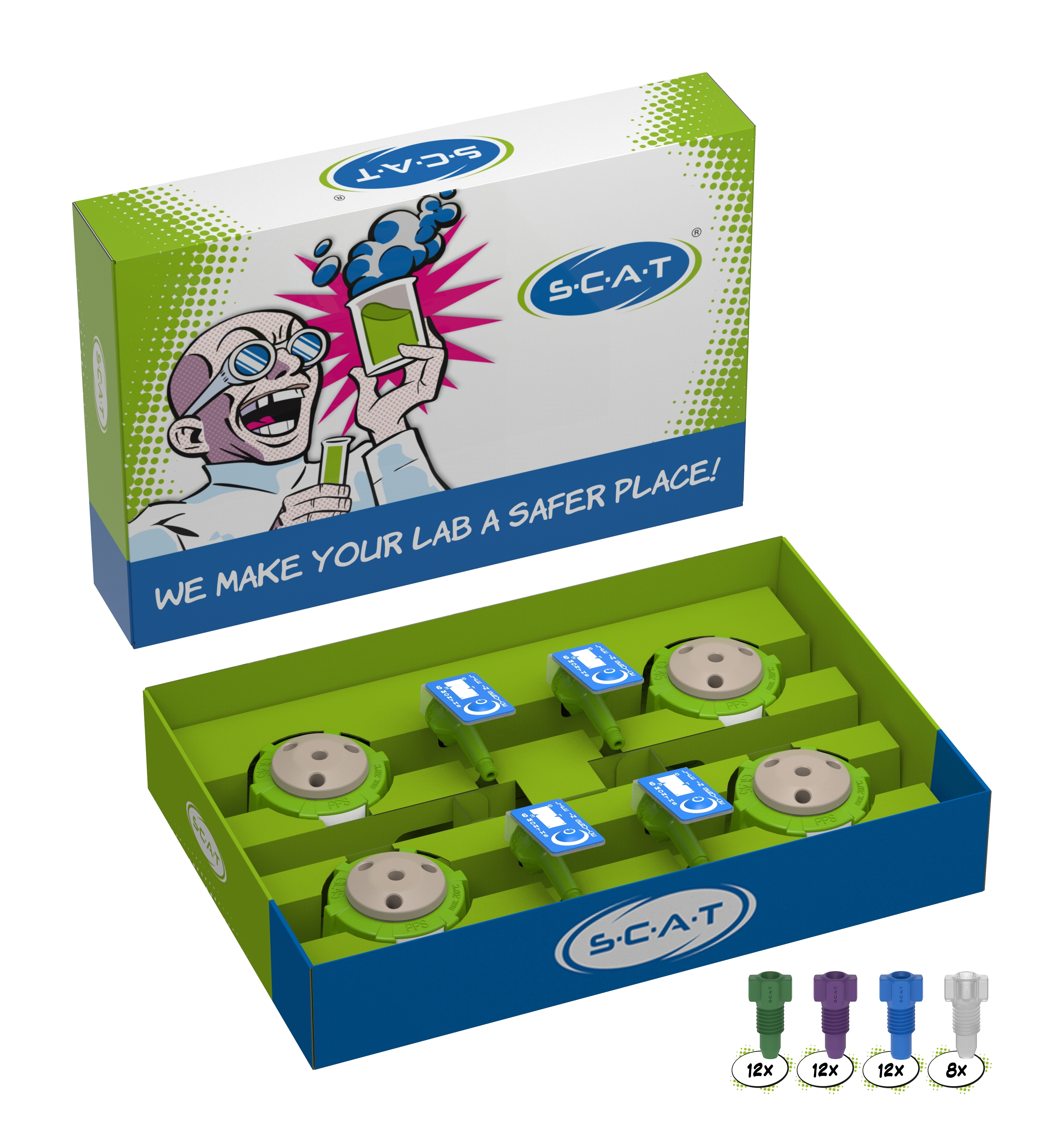


Frequently asked questions about GreenLine and PFAS-sensitive analysis
Which Safety Cap is suitable for PFAS-sensitive applications?
For PFAS-sensitive applications and intentionally fluorine-free media paths, SCAT offers Safety Caps with a PEEK core. PEEK is a fluorine-free high-performance polymer, mechanically stable and suitable for many typical HPLC eluents. Its chemical resistance must nevertheless be assessed for the specific application.
Why does SCAT now use PEEK instead of PP?
PP cores were previously used as an interim solution while no suitable PEEK core was available. With the PEEK core, a solution with higher chemical and mechanical performance is now available for PFAS-sensitive applications. SCAT therefore no longer offers Safety Caps with a PP core.
Which components are part of a fluorine-free GreenLine supply system?
A PFAS-free media path means that all media-contacting components relevant to the application are designed without PFAS or fluoropolymers. A typical GreenLine configuration consists of: Suitable, non-fluorinated PE-HD bottle; Safety Cap with PEEK core; PEEK capillaries; PE fittings; PE blind plugs; GreenLine vent valve; UHMW-PE inlet filter A single PEEK component or a PE-HD bottle therefore does not make the supply system completely PFAS-free. The decisive factor is a consistent assessment of the entire relevant media path. Possible inputs from manufacture, packaging, cleaning, previous use and laboratory handling must also be considered. For sensitive methods, the complete system should be checked using blanks or system blanks.
Why is PE-HD often used instead of glass for PFAS-sensitive applications?
Glass surfaces can adsorb PFAS compounds that are already present and release them again under changed conditions. In trace analysis, this can affect recovery and reproducibility. A suitable, non-fluorinated PE-HD bottle supports a fluorine-free media path and reduces glass-related adsorption effects.
Does a PE-HD bottle guarantee a PFAS-free analysis?
No. Manufacturing, packaging, cleaning, previous use and handling can also cause background signals. The complete media path must therefore be considered and checked using suitable blanks or system blanks.
Is PEEK generally better than PTFE?
No. The two materials meet different requirements. PTFE is the established standard for conventional HPLC applications because it offers particularly broad chemical resistance and is flexible as a capillary material. PEEK is PFAS-free, mechanically more dimensionally stable and therefore particularly relevant for PFAS-sensitive or intentionally PFAS-free media paths. However, PEEK is stiffer, and its chemical resistance must be assessed for the specific application when unusually aggressive, strongly oxidising or highly concentrated media are used. Neither material is generally better; the specific method is what matters.
What is the difference between the standard and GreenLine vent valves?
The standard vent valve has a PTFE filter membrane and is intended for conventional analytical and preparative HPLC applications. The GreenLine vent valve uses a fluorine-free filter membrane and is part of a coordinated PFAS-sensitive supply system.
Which inlet filters does SCAT offer for conventional and PFAS-sensitive applications?
For conventional applications, an inlet filter made of PFA/PTFE with a pore size of 5 µm is available. For PFAS-sensitive systems, a fluorine-free version made of UHMW-PE with a pore size of 20 µm is used. The different pore size must be taken into account in system design and priming.

